No runs scheduled yet. Set a room or trunk CFM above, enter a label (e.g.,
Master Bedroom), and click + Add Run to Duct Schedule
— or load a 4-run sample layout.
Scheduled Runs0 / 10Add rooms or trunks
Total System CFM0 CFMCombined scheduled airflow
Recommended AC Tonnage—@ 400 CFM / ton nominal
Est. Main Metal Trunk—Sheet metal @ 0.08 in. wg
Common US Residential Duct Sizing Benchmarks
Calculated at standard sea-level air density (0.075 lb/ft³, 70°F) using ASHRAE 2025 Chapter 21
Darcy-Weisbach friction loss. Compare the 100 CFM bedroom run in galvanized steel
(ε = 0.0003 ft, exact 6.07") versus fully extended flexible wire-helix duct
(ε = 0.003 ft, exact 6.37")—both step to 7" nominal to stay ≤ 0.08 in. wg, while
larger trunks diverge by a full nominal diameter as wall roughness compounds.
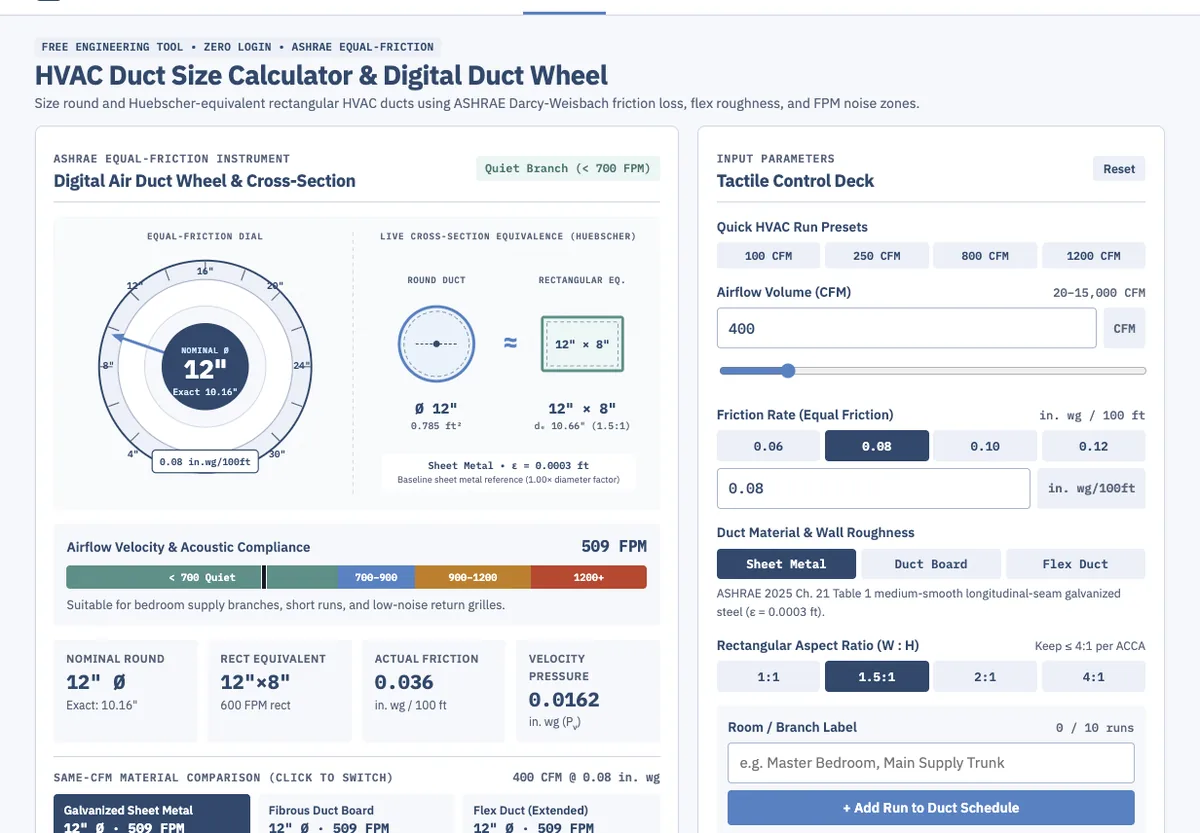
Worked Field Example: 400 CFM Equal-Friction Sizing Readout
Entering 400 CFM at 0.08 in. wg/100 ft in galvanized sheet metal yields an exact diameter of
10.16", stepping to a 12" nominal round trunk (509 FPM quiet acoustic band, 0.036
in. wg/100 ft actual friction) or a 12"×8" Huebscher rectangular equivalent
(dₑ = 10.66").
Real DuctCFM workbench capture for a 400 CFM galvanized supply run at 0.08 in. wg/100 ft
showing the rotary equal-friction dial, Huebscher rectangular cross-section equivalence, and
three-material roughness comparison.
f' = 0.11 × (12·ε / d + 68 / Re)^0.25

f = f' (if f' ≥ 0.018), else 0.85·f' + 0.0028

ΔP₁₀₀ = f × (1200 / d) × (V / 4005)²
Published ASHRAE Ch. 21 Table 1 roughness ε: Galvanized Steel = 0.0003 ft, Preformed Rigid
Fibrous Duct Board = 0.003 ft, Fully Extended Nonmetallic/Wire Flex Duct = 0.003 ft
(Table 1 range 0.0003–0.003 ft; Example 6 design value 0.003 ft).
2. Huebscher Round-to-Rectangular Equivalent
Rectangular duct sizing matches equal friction per unit length (not equal cross-sectional
area) via Huebscher’s equivalent diameter equation:
dₑ = 1.30 × (W × H)^0.625 / (W + H)^0.25

V = CFM / ((W × H) / 144)
Nominal US sheet metal recommendations strictly satisfy dₑ ≥ exact diameter
and snap to standard even-inch dimensions (e.g., 12×8, 16×8, 20×10) while keeping nominal
round friction at or below your chosen friction rate.
What This Calculator Does Not Cover (Design Limits)
Fitting Equivalent Lengths & Coil Static Drop: This tool sizes straight
duct sections at your chosen friction rate (20–15,000 CFM single-duct range). It does not
subtract evaporator coil, air filter, damper, or grille static pressure drops from blower
ESP as required by
ACCA Manual D
.
High-Altitude Air Density: Formulas assume sea-level air (0.075 lb/ft³).
Above 3,500 ft elevation (e.g., Denver, Salt Lake City), thinner air reduces friction loss
slightly while requiring higher volumetric CFM to move the same sensible heat.
Compressed or Pinched Flex Duct: The ASHRAE Ch. 21 Example 6 roughness
(ε = 0.003 ft) assumes flexible duct is pulled fully taut with minimal sag per
DOE duct installation best practices
. Longitudinal compression of 15%–30% can multiply straight pressure drop by 1.5×–3.0×
(Pressure Drop Correction Factor) beyond these straight-extended values.
HVAC Duct Sizing Field FAQ
Why does a 6-inch flex duct carry less CFM than a 6-inch galvanized sheet metal duct?
Under ASHRAE 2025 Fundamentals Chapter 21 Table 1 & Example 6, fully extended nonmetallic wire-helix flexible duct has a design wall roughness of ε = 0.003 ft (10× rougher than smooth longitudinal-seam galvanized steel at ε = 0.0003 ft). At 0.08 in. wg per 100 ft, a 6-inch galvanized duct carries roughly 97 CFM (96.93 exact), whereas a fully extended 6-inch flex duct carries roughly 85 CFM (85.39 exact)—and any field compression or sag drops airflow further. Stepping up one nominal diameter prevents starved rooms and excessive blower static pressure.
What friction rate should I use for residential HVAC ductwork?
Most US residential installations fall between 0.06 and 0.10 in. wg per 100 ft of equivalent length, with 0.08 in. wg serving as the common preliminary starting point when an ACCA Manual D friction rate worksheet has not yet been completed. Actual Manual D design calculates Available Static Pressure (ASP) divided by Total Effective Length (TEL) × 100.
How is rectangular duct width and height converted from a round duct diameter?
You cannot simply match cross-sectional area because rectangular ducts have more perimeter surface drag per square foot than circles. HVAC engineers use Huebscher’s equation: d_e = 1.30 × (a × b)^0.625 / (a + b)^0.25. Keeping aspect ratios at or below 4:1 avoids excess static loss and sheet-metal oil-canning.
At what velocity (FPM) do residential air ducts start making noticeable noise?
For quiet residential branches and bedrooms, ACCA Manual D recommends keeping airflow under 600–700 FPM. Main supply trunks can typically run 700–900 FPM behind drywall or in basements. Once velocity exceeds 900–1,000 FPM, air turbulence at takeoffs, elbows, and register dampers creates audible rush noise.
Does this digital duct wheel include fittings, elbows, and boots?
No. Equal-friction sizing determines straight-run duct diameter per 100 ft of effective length. Every 90-degree elbow, takeoff collar, damper, and floor boot adds equivalent length (often 10–45 ft each). To design a full permit-ready system, sum all straight lengths plus fitting equivalent lengths into your Manual D friction rate worksheet first.